Current Location: Gallery 32 (Rothschild)
Titles
The Annunciation
Maker(s)
Maker:
Unknown
Entities
Categories
Description
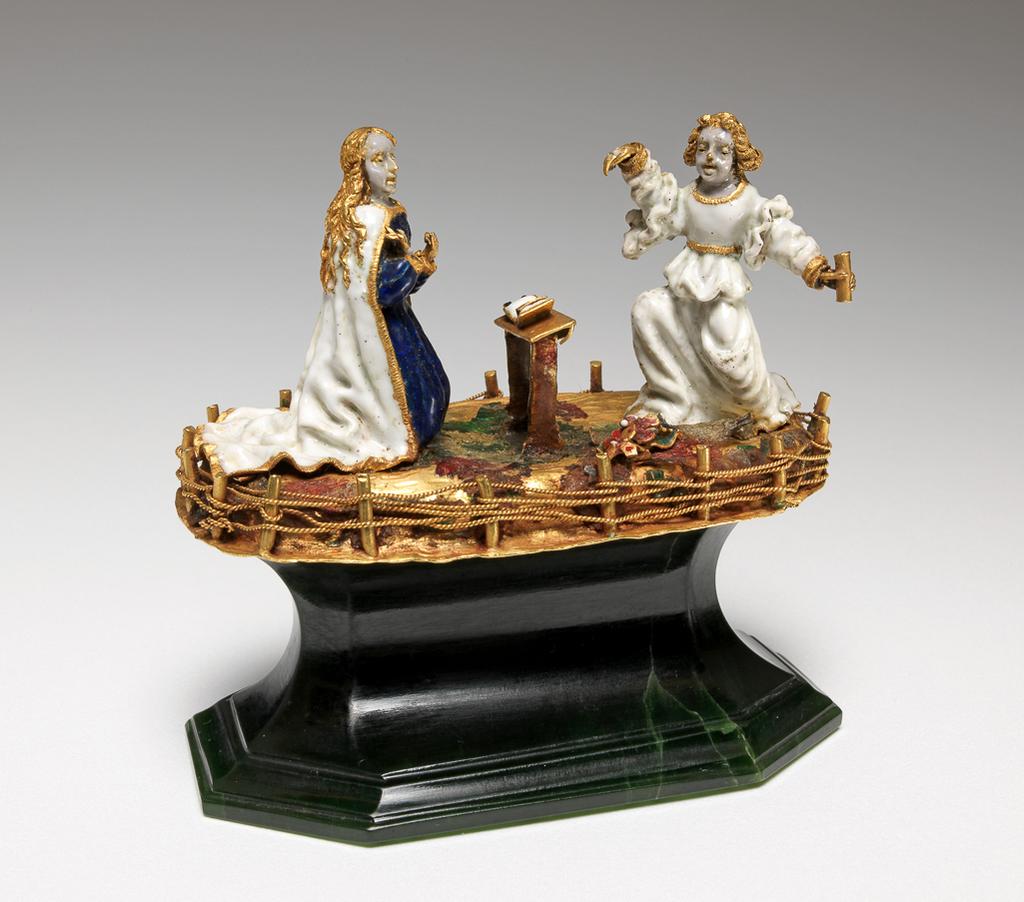
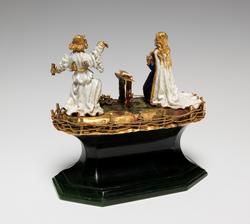
Gold, enamelled en ronde bosse with opaque white, and translucent blue, red and green enamels, on a later wooden base. The kneeling figures of the Virgin and the Angel Gabriel are surrounded by a low fence composed of three strands of twisted gold wire looped round short vertical poles.
Notes
History note: Geistliche Schatzkammer (Spiritual Treasury), Vienna; uncertain date in the 1860s, Salomon Weininger (1822-79); uncertain before testator
Legal notes
L.D. Cunliffe Bequest, 1937
Measurements and weight
Height: 3.7 cm
Width: 6.7 cm
Acquisition and important dates
Method of acquisition: Bequeathed
(1938)
by
Cunliffe, Leonard Daneham
Dating
15th Century, Early
Circa
1400
CE
-
Circa
1450
CE
Note
The rare Annunciation group may originally have formed part of a reliquary. It is unusual in showing the Annunciation taking place in an enclosed garden (hortus conclusus) instead of the more usual an interior setting. It was formerly in the Spiritual Treasury of the Imperial Hapsburg Court in Vienna. Between about 1865 and 1870 it was sent for restoration to a dealer, Salomon Weininger (1822-79), who returned a copy and sold the original to an unknown collector. The fraud remained unnoticed until the twentieth century, but Weininger was imprisoned for a similar offence in 1876. The dark green stone base is a later replacement, and may have been made in Vienna in the 1860s by Salomon Weininger's assistants.
The Annunciation illustrates the technique of enamelling directly onto a three-dimensional gold surface, known as ‘émail en ronde bosse’ which was perfected in France and Burgundy around 1400. It was previously attributed to a Parisian goldsmith active in the early fifteenth century, but is now believed to have been made in the Burgundian Netherlands around the middle of the century, on account of its similarities with a Burgundian brooch datable to c. 1430-40 in the Weitliche Schatzkammer, Vienna.
School or Style
Late Medieval
People, subjects and objects depicted
Components of the work
Decoration
composed of
enamel
( opaque white, and translucent blue, red and green)
Base
composed of
wood
Figures
Materials used in production
Gold
References and bibliographic entries
Related exhibitions
Identification numbers
Accession number: M/P.22-1938
Primary reference Number: 118318
Stable URI
Audit data
Created: Saturday 6 August 2011
Updated: Tuesday 26 March 2024
Last processed: Thursday 14 August 2025
Associated departments & institutions
Owner or interested party:
The Fitzwilliam Museum
Associated department:
Applied Arts