The low-resolution images published on this Website are made available under a Creative Commons Attribution licence (CC BY-NC-ND). For more details: Fitzwilliam Terms of Use
This licence does not include any images of works that are still in copyright. Artistic copyright extends from the life of the artist to 70 years from the end of the calendar year in which the artist died.
Download this imageFor further information on use of images or to license a high resolution version, please contact our image library who can discuss terms and fees.

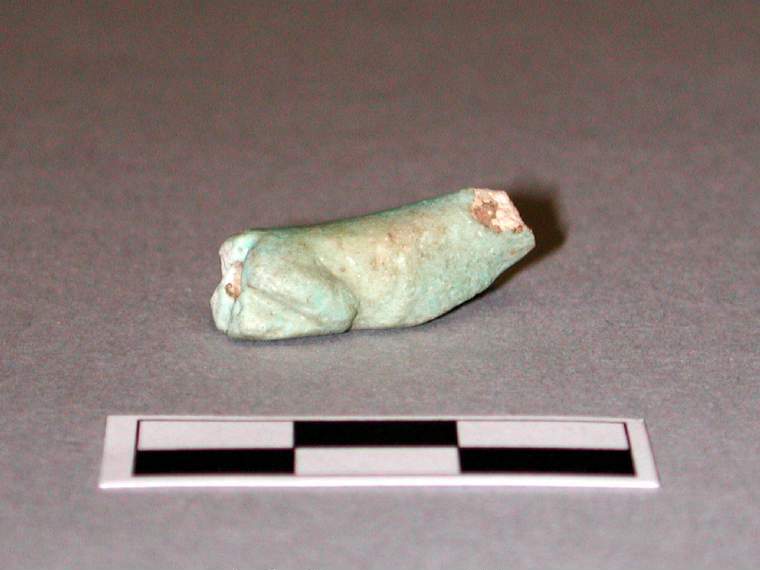
Faience scorpion, probably part of a necklace as a protective amulet (charm). the head and tail are missing but there is a hole through the centre. One of several found in this temple deposit and possibly a reference to the 'Scorpion King' who ruled before Narmer (the first king whose name we know). Scorpions were also believed to protect as well as threaten. Here, in a royal context it seems more likely that the animal protected the king because of its close association with early Egyptian royalty. Faience is a glazed crushed quartz.
Length: 2.2 cm
Method of acquisition: Given (1898) by Egyptian Research Account
Predynastic
Early Dynastic Period
About
-3000
-
About
-2500
Accession number: E.105.1898
Primary reference Number: 49662
Oldadmincategory: FG
Stable URI
Owner or interested party:
The Fitzwilliam Museum
Associated department:
Antiquities
This record can be cited in the Harvard Bibliographic style using the text below:
The Fitzwilliam Museum (2025) "Amulet" Web page available at: https://collection.beta.fitz.ms/id/object/49662 Accessed: 2025-12-09 06:25:46
To cite this record on Wikipedia you can use this code snippet:
{{cite web|url=https://collection.beta.fitz.ms/id/object/49662
|title=Amulet
|author=The Fitzwilliam Museum|accessdate=2025-12-09 06:25:46|publisher=The
University of Cambridge}}
To call these data via our API (remember this needs to be authenticated) you can use this code snippet:
https://collection.beta.fitz.ms/api/v1/objects/object-49662
To use this as a simple code embed, copy this string:
<div class="text-center">
<figure class="figure">
<img src="https://data.fitzmuseum.cam.ac.uk/imagestore/ant/ant7/E_105_1898.jpg"
alt="Amulet"
class="img-fluid" />
<figcaption class="figure-caption text-info">Amulet</figcaption>
</figure>
</div>
Updates about future exhibitions and displays, family activities, virtual events & news. You'll be the first to know...