Current Location: Gallery 27 (Glaisher)
Titles
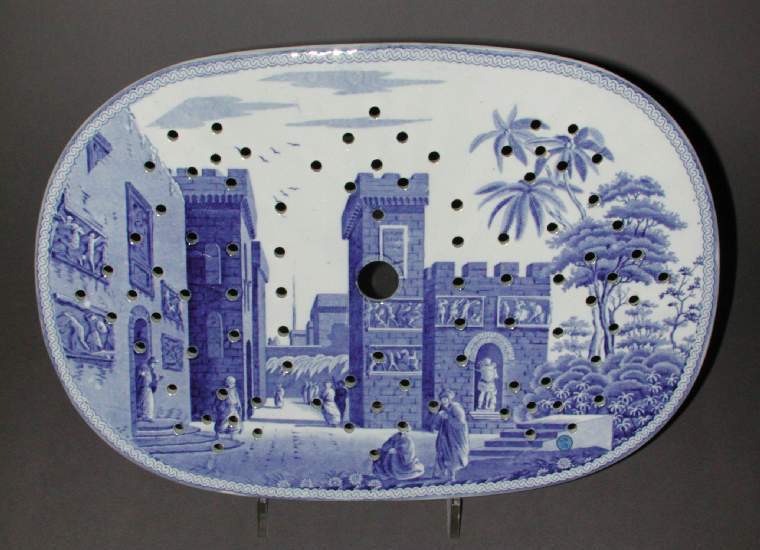
The Castle of Boudron in the Gulf of Stancio
Maker(s)
Factory:
Spode
Entities
Categories
Description
White earthenware dish drainer, transfer-printed underglaze in blue with the Castle of Boudron in the Gulf of Stancio.
White earthenware, transfer-printed underglaze in blue. Oval with a large central hole surrounded by groups of smaller holes. The Castle of Boudron in the Gulf of Stancio from the Caramanian series, surrounded by a guilloche-like narrow border.
Notes
History note: Purchased from D. Seligman, September, 1970 by the donors.
Legal notes
Given from the Robert and Elizabeth Hirsch Collection.
Measurements and weight
Depth: 2.1 cm
Length: 37.2 cm
Width: 25.6 cm
Acquisition and important dates
Method of acquisition: Given
(1991)
by
Robert and Elizabeth Hirsch Collection
Dating
19th Century, Early
Circa
1805
CE
-
1820
CE
Note
Dish drainers were placed on top of large serving dishes so that the juices of fish and meat could run through the holes into the dish beneath. They were sometimes referred to as 'fish plates' or when made of pewter or silver, as 'mazarines' or 'mazareens'.
Topographical views were fashionable as prints on tableware during the late 18th and early 19th century.The design on this drainer,'The Castle of Boudron in the Gulf of Stancio' was one of the 'Caramanian' series first produced by Spode in 1809. Caramania was the ancient name of an area on the southern coast of Turkey. The designs were taken from Volume II of 'Views of Egypt, Palestine and the Ottoman Empire', entitled,' Views in the Ottoman Empire chiefly in Caramania, a part of Asia Minor hitherto unexplored.....from the original drawings in the possession of Sir R. Ainslie, taken during his embassy to Constantinople' by Luigi Mayer.
Components of the work
Decoration
composed of
ceramic printing colour
( cobalt-blue)
Materials used in production
Lead-glaze
Earthenware
Techniques used in production
Moulding
: White earthenware, pierced, and transfer-printed underglaze in blue
Lead-glazing
Pierced
Inscription or legends present
- Text: Spode 8
- Location: On base
- Method of creation: Impressed
- Type: Mark
- Text: D
- Location: On base
- Method of creation: Transfer-printed in blue
- Type: Mark
References and bibliographic entries
Identification numbers
Accession number: C.1-1991
Primary reference Number: 71536
Stable URI
Audit data
Created: Saturday 6 August 2011
Updated: Tuesday 31 December 2024
Last processed: Tuesday 13 May 2025
Associated departments & institutions
Owner or interested party:
The Fitzwilliam Museum
Associated department:
Applied Arts