Current Location: In storage
Maker(s)
Production:
Unidentified Staffordshire Potter
Entities
Categories
Description
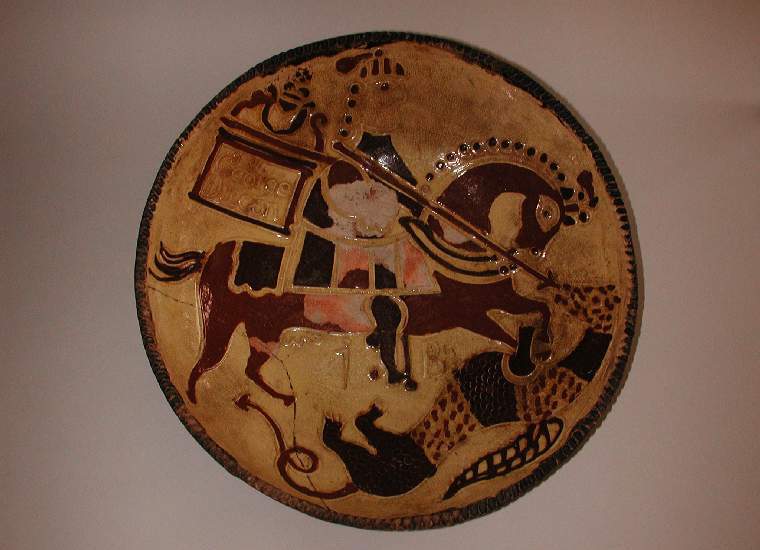
Slipware dish decorated with St George and the Dragon
Pale red earthenware, press-moulded over a hump mould to produce a design in relief on the interior, coated in cream slip, and slip-trailed in brown and dark brown under yellowish lead-glaze; the reverse is undecorated. The dish is circular with deep curved sides and a crinkled edge produced by making adjacent impressions with an oval implement. St George rides a horse towards the viewer's right, and spears the scaly dragon which lies on the ground below the horse. Behind St George is an inn sign inscribed in relief St/George/Dragon, with above, a coat-of-arms flanked by scrolls. The initials IB (JB) are moulded in relief below the horse, on either side of St George's leg.
Notes
History note: F. J. Morrell, 48 Liverpool Road, Stoke on Trent, from whom bought for £55 on 2 December 1928, while at Bournemouth by Dr J.W.L. Glaisher, FRS, Trinity College, Cambridge.
Legal notes
Dr J. W. L. Glaisher Bequest
Measurements and weight
Diameter: 40.6 cm
Height: 9.2 cm
Acquisition and important dates
Method of acquisition: Bequeathed
(1928-12-07)
by
Glaisher, J. W. L., Dr
Dating
18th Century, first half
Circa
1715
-
1740
Note
St George is the patron saint of England, whose feast day is 23 April. St George's legendary slaying of a dragon was a well-known story, and the George and Dragon was a popular name for inns and taverns. It therefore seems highly likely that dishes like this, which include a sign as part of the design, could have been made for one of them. A dish in the British Museum was probably made from the same mould, but is decorated in dark brown slip only, and has a dragon whose body had the same pattern all over it, except for the head, legs, wing, and tail. (inv. no. 1887,0307,D.43)
People, subjects and objects depicted
Components of the work
Inside Decoration
composed of
slip
( cream, brown, and dark brown)
Inside Surface
composed of
lead-glaze
Inside
Materials used in production
pale red
Earthenware
Techniques used in production
Press-moulding
: Pale red earthenware, press-moulded over a hump mould to produce a design in relief on the inside, coated with cream slip, slip-trailed in brown and dark brown, and lead-glazed; the exterior is undecorated
Inscription or legends present
- Text: St/George/Dragon
- Location: On front on inn sign
- Method of creation: Moulded in relief
- Type: Inscription
Inscription present: the J appears as a dotted long tapering I
- Text: IB (JB)
- Location: Below horse
- Method of creation: Integrally moulded
- Type: Initials
References and bibliographic entries
Identification numbers
Accession number: C.197-1928
Primary reference Number: 72921
Old object number: 4945
Stable URI
Audit data
Created: Saturday 6 August 2011
Updated: Friday 27 December 2024
Last processed: Tuesday 15 July 2025
Associated departments & institutions
Owner or interested party:
The Fitzwilliam Museum
Associated department:
Applied Arts