Current Location: In storage
Maker(s)
Production:
Unidentified
Entities
-
Bottle
- double-gourd shaped bottle
Categories
Description
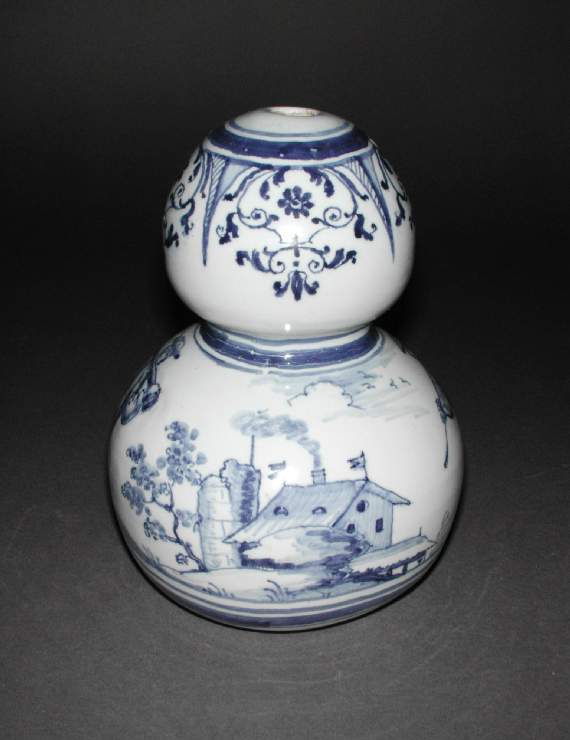
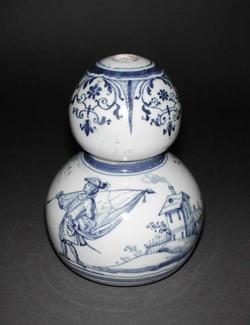
Tin-glazed earthenware painted in blue on the lower part with buildings and two soldiers in a landscape, and on the upper part with a scrollwork border, and dated '1732' on the base
Earthenware, thrown, tin-glazed overall, and painted in blue. The bottle is of bulbous double-gourd shape with a circular aperture in the top, and a slight concavity in the middle of the base, with three stilt marks outside it. The lower part is decorated with a continuous landscape with two houses and the tip of a church spire on one side, and on the other, a tree, a ruined tower and another house or fort with a pennant flying at each end of the roof. Between the buildings on one side is a soldier carrying a flag in his right hand and resting his left on the hilt of his sword while walking to the left, and on the other, a soldier carrying a gun over his shoulder and walking to the right. Both wear tricorne hats, coats with wide cuffs to the sleeves, breeches and shoes. Below there is a wide blue horizontal band between two narrow, and this is repeated at the junction of the two parts, and round the aperture in the top. Below that is a wide border comprising four scrollwork motifs with pointed partly hatched projections between them. The date, '1732' is painted on the base.
Notes
History note: The Vicarage, Haslingfield, Cambridgeshire; sale held there on 3 June 1898, part of lot 137; bought by Mr Freeman; Mr Freeman’s sale at Cambridge, 27 January 1904, lot 31 or lot 63 (both mentioned in catalogue entry by purchaser); bought by Dr J.W.L. Glaisher, FRS, Trinity College, Cambridge.
Legal notes
Dr J. W. L. Glaisher Bequest
Measurements and weight
Diameter: 12.9 cm
Height: 17.2 cm
Acquisition and important dates
Method of acquisition: Bequeathed
(1928-12-07)
by
Glaisher, J. W. L., Dr
Dating
1730s
Production date:
dated
AD 1732
: this date was before the founding of the Lyon factory in 1733
Note
This bottle was attributed to Lyons in Bernard Rackham's Catalogue of the Glaisher Collection . . . . (1935), but the 18th century Lyon faïence factory was not founded until 1733 by Joseph Combe, a faïencier from Moustiers.
People, subjects and objects depicted
Components of the work
Decoration
composed of
high temperature colour
( blue from cobalt oxide)
Surface
composed of
tin-glaze
Materials used in production
Earthenware
Inscription or legends present
- Text: 1732 underlined
- Location: On base
- Method of creation: Painted in blue
- Type: Date
References and bibliographic entries
Identification numbers
Accession number: C.2346-1928
Primary reference Number: 73385
Old object number: 1946
Stable URI
Audit data
Created: Saturday 6 August 2011
Updated: Monday 4 August 2025
Last processed: Monday 4 August 2025
Associated departments & institutions
Owner or interested party:
The Fitzwilliam Museum
Associated department:
Applied Arts