Current Location: In storage
Maker(s)
Production:
Baylon Factory
Entities
Categories
Description
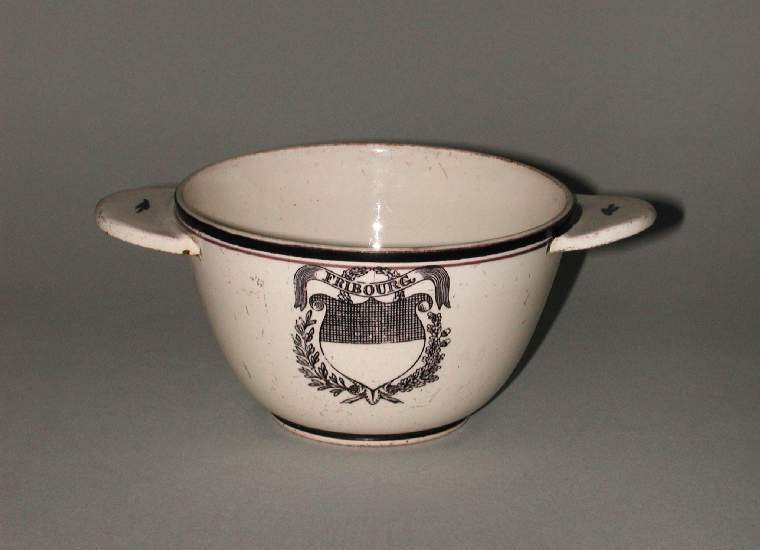
Cream-coloured earthenware transfer-printed with the arms of Fribourg
Cream-coloured earthenware (faïence fine), transfer-printed in black and painted in very dark manganese-brown enamel. The circular bowl has deep curved sides and two projecting, flat D-shaped lugs. The front is printed in black with the arms of Fribourg with the name FRIBOURG on a ribbon over it. There are dark brown bands round the edge of the base and rim, and on the top of each lug, an arrow.
Notes
History note: Mr Dreyfus, Geneva, from whom bought for 7 francs on 22 February 1904 by Dr J.W.L. Glaisher, FRS, Trinity College, Cambridge
Legal notes
Dr J. W. L. Glaisher Bequest
Measurements and weight
Height: 6.5 cm
Width: 15.6 cm
Acquisition and important dates
Method of acquisition: Bequeathed
(1928-12-07)
by
Glaisher, J. W. L., Dr
Dating
19th Century, second quarter
Circa
1825
-
1850
Note
The Baylon Factory operated between 1812 and 1879. It was founded by Abraham Baylon and his father- in-law Antoine Franck in rue Caroline, Carouge, and the company was registered in 1813 as Baylon & Co. In 1817 it became a limited company, Baylon & Comp. and in 1827, a joint stock company. After the death of Abraham Baylon in 1829, and of Antoine Franck in 1830, the enterprise was directed by Marie Madeleine, the widow of Baylon, and was titled Veuve Baylon & Cie. From 1836 her son Antoine Baylon, joined her and it became Veuve Baylon & Fils. Antoine became the sole proprietor in 1843, and on his death in 1866, his widow, Fanny Baylon-Lautard took over. The mark BAYLON, which appears most often on their products, was probably introduced in the early 1820s.
This porringer is a typical Swiss form, known as a bol à oreilles because of its projecting flat lugs reminiscent of ears. Fribourg is the capital city of the Swiss Canton of the same name. I
Components of the work
Decoration
composed of
ceramic printing colour
( black)
enamel
( dark manganese-brown)
Surface
composed of
glaze
( clear, probably lead-glaze)
Rim
Diameter 11 cm
Materials used in production
cream
Earthenware
Techniques used in production
Moulding
: Cream-coloured earthenware, moulded with applied lugs, clear glazed, transfer-printed onglaze in black, and painted in dark manganese-brown
Inscription or legends present
- Text: BAYLON
- Location: On base
- Method of creation: Impressed and darkened
- Type: Factory mark
References and bibliographic entries
Identification numbers
Accession number: C.1972-1928
Primary reference Number: 76556
Old object number: 2033
Stable URI
Audit data
Created: Saturday 6 August 2011
Updated: Tuesday 23 September 2025
Last processed: Tuesday 23 September 2025
Associated departments & institutions
Owner or interested party:
The Fitzwilliam Museum
Associated department:
Applied Arts