The low-resolution images published on this Website are made available under a Creative Commons Attribution licence (CC BY-NC-ND). For more details: Fitzwilliam Terms of Use
This licence does not include any images of works that are still in copyright. Artistic copyright extends from the life of the artist to 70 years from the end of the calendar year in which the artist died.
Download this imageFor further information on use of images or to license a high resolution version, please contact our image library who can discuss terms and fees.
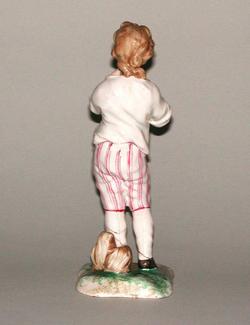
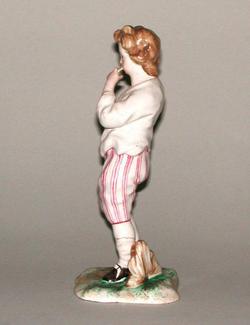
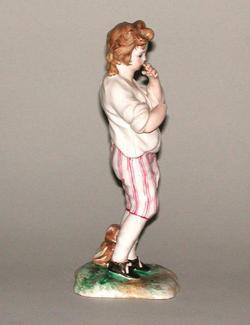
Boy Playing a Flute
Production: Hannong factory
Tin-glazed earthenware painted in enamels
Pale buff earthenware, moulded, tin-glazed and painted overglaze in green, pale pink, puce pink, brown, and black enamels (petit feu decoration). The figure is supported on a square base with rounded corners, and slopes upwards slightly towards the back, where there are two stones. Its surface is mottled in shades of green and brown, and the stones are brown. The boy stands on his left foot with right foot a little behind it, and his right knee relaxed. In his left hand he holds the upper part of a whistle to his mouth,; its lower part is missing. The wrist and hand of his right arm have been broken off. He has brown curling hair, which forms a bunch on the nape of his neck at the back. He wears a white open-necked shirt, and breeches with puce stripes, white stockings, and black shoes with white bows.
History note: Mr J. Nachemsohn, King Street, St James’ Square, from whom bought for £4 on 20 April 1918 for £4, by Dr J.W.L. Glaisher, FRS, Trinity College, Cambridge
Dr J. W. L. Glaisher Bequest
Height: 17 cm
Method of acquisition: Bequeathed (1928-12-07) by Glaisher, J. W. L., Dr
18th Century, third quarter
Circa
1770
-
1775
The Hannong faïence factory in Strasbourg had been founded in 1721 by Jean-Henri Wachenfeld and Charles-François Hannong, who from 1724 was the director of the firm. He retired in 1732 and his eldest son, Paul-Antoine Hannong took over. The family also had a factory at Hagenau, which was run by a younger brother, Balthazar Hannong until 1737. From 1760 the director of the Strasbourg factory was Paul-Antoine's son, Joseph-Adam Hannong who directed the enterprise until 1781. The figure may have been produced from a model by Johann Wilhelm Lanz (1725-64).
Decoration
composed of
enamels
( shades of green, pink, puce, red, brown, and black)
Surface
composed of
tin-glaze
Base
Width 6.2 cm
pale buff Earthenware
Moulding
: Pale buff earthenware, moulded in parts, assembled, tin-glazed, and painted overglaze in shades of green, pink, puce, red, brown, and black enamels
Tin-glazing
Accession number: C.2362-1928
Primary reference Number: 76729
Old object number: 3891
Stable URI
Owner or interested party:
The Fitzwilliam Museum
Associated department:
Applied Arts
This record can be cited in the Harvard Bibliographic style using the text below:
The Fitzwilliam Museum (2025) "Boy Playing a Flute" Web page available at: https://collection.beta.fitz.ms/id/object/76729 Accessed: 2025-12-05 16:58:53
To cite this record on Wikipedia you can use this code snippet:
{{cite web|url=https://collection.beta.fitz.ms/id/object/76729
|title=Boy Playing a Flute
|author=The Fitzwilliam Museum|accessdate=2025-12-05 16:58:53|publisher=The
University of Cambridge}}
To call these data via our API (remember this needs to be authenticated) you can use this code snippet:
https://collection.beta.fitz.ms/api/v1/objects/object-76729
To use this as a simple code embed, copy this string:
<div class="text-center">
<figure class="figure">
<img src="https://data.fitzmuseum.cam.ac.uk/imagestore/aa/aa1/C_2362_1928_281_29.jpg"
alt="Boy Playing a Flute"
class="img-fluid" />
<figcaption class="figure-caption text-info">Boy Playing a Flute</figcaption>
</figure>
</div>
Updates about future exhibitions and displays, family activities, virtual events & news. You'll be the first to know...