The Sabbatai Ring: M/P.1-1914

An image of Ring

Terms of use

The low-resolution images published on this Website are made available under a Creative Commons Attribution licence (CC BY-NC-ND). For more details: Fitzwilliam Terms of Use

This licence does not include any images of works that are still in copyright. Artistic copyright extends from the life of the artist to 70 years from the end of the calendar year in which the artist died.

Download this image

For further information on use of images or to license a high resolution version, please contact our image library who can discuss terms and fees.
Alternative views

Object information

Current Location: In storage

Titles

The Sabbatai Ring

Maker(s)

Designer: Ricketts, Charles de Sousy

Entities

Categories

Description

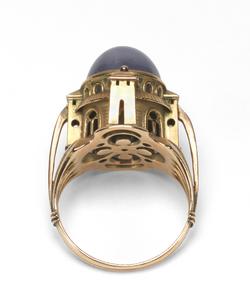
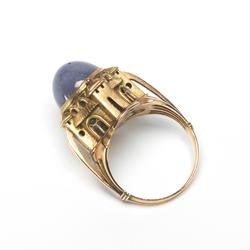
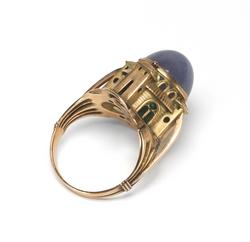
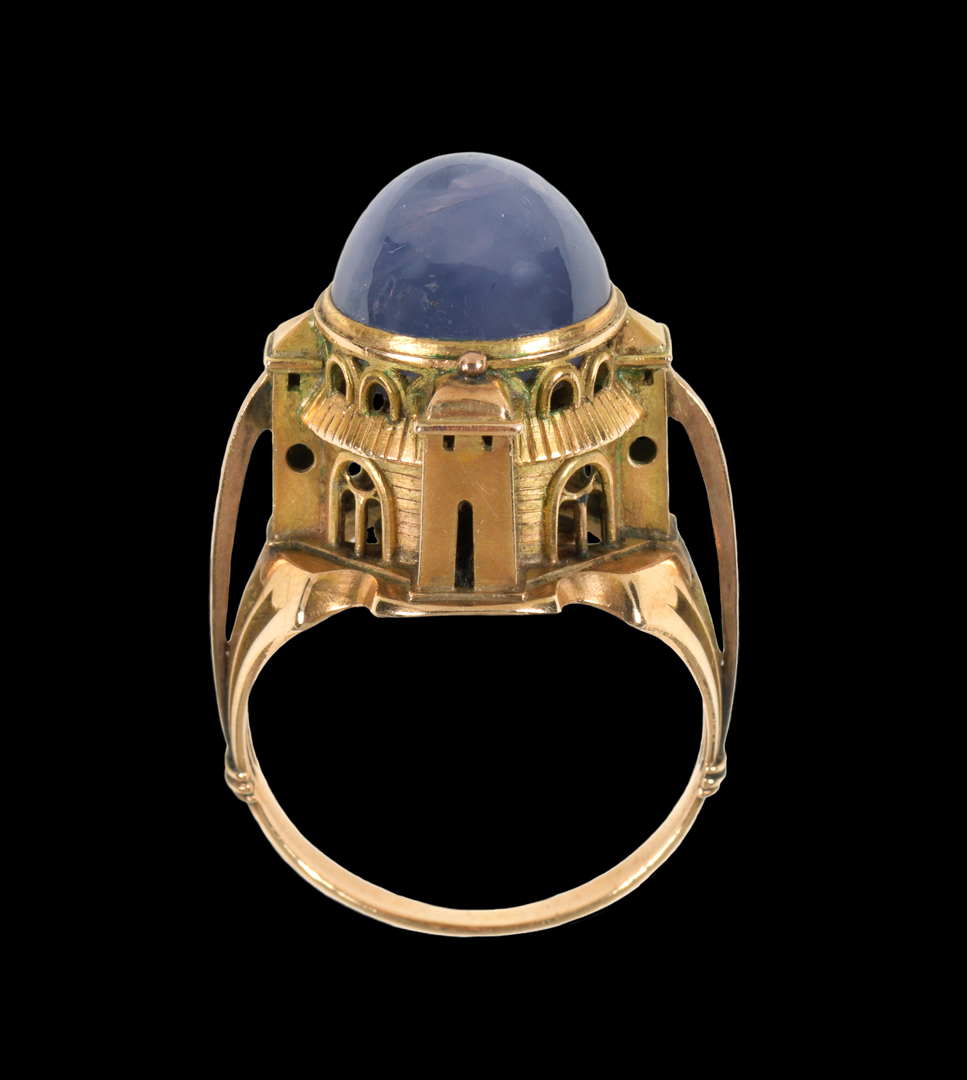
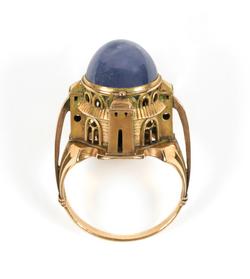
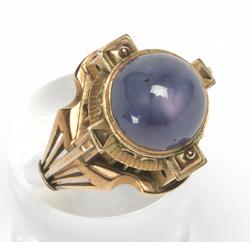
Gold, set with a cabochon star sapphire, the hollow interior containing a loose emerald. The shoulders of the ring are each pierced by four long tapering holes, and the bezel is in the form of a mosque with tower-like buttresses, four pierced doorways, each with a sloping roof and two arched windows above. The dome is formed by the cabochon star sapphire, and inside is a loose emerald. The doors were originally smeared with ambergris.

Notes

History note: Designed and commissioned by Charles Ricketts for Miss Bradley. Given to her by Ricketts on 5th February, 1904.

Legal notes

Bequeathed by Miss Katherine H. Bradley

Acquisition and important dates

Method of acquisition: Bequeathed (1914) by Bradley, Katherine H., Miss

Dating

20th Century, Early
Edwardian
Production date: AD 1904 : The wax model for the ring was completed on 8 January, 1904 and the ring was given to Miss Katherine Bradley (1846-1914) by Ricketts on 5 February 1904.

Note

Ricketts promised to make a ring for Miss Bradley in December 1903. The form was inspired by the story of Sabbatai Sebi (1626-76), a Jewish mystic, who having proclaimed himself Messiah in Jerusalem, was later converted to Islam. It represents the mosque of Omar, and was intended to appeal to the five senses. See Documentation, Scarisbrick, 1982.

Citation for print

This record can be cited in the Harvard Bibliographic style using the text below:

The Fitzwilliam Museum (2025) "The Sabbatai Ring" Web page available at: https://collection.beta.fitz.ms/id/object/93551 Accessed: 2025-12-05 11:17:28

Citation for Wikipedia

To cite this record on Wikipedia you can use this code snippet:

{{cite web|url=https://collection.beta.fitz.ms/id/object/93551 |title=The Sabbatai Ring |author=The Fitzwilliam Museum|accessdate=2025-12-05 11:17:28|publisher=The University of Cambridge}}

API call for this record

To call these data via our API (remember this needs to be authenticated) you can use this code snippet:

https://collection.beta.fitz.ms/api/v1/objects/object-93551

Bootstrap HTML code for reuse

To use this as a simple code embed, copy this string:

<div class="text-center">
    <figure class="figure">
        <img src="https://data.fitzmuseum.cam.ac.uk/imagestore/aa/aa37/M_P_1_1914_9_201702_amt49_dc2.jpg"
        alt="The Sabbatai Ring"
        class="img-fluid" />
        <figcaption class="figure-caption text-info">The Sabbatai Ring</figcaption>
    </figure>
</div>
    

Sign up for updates

Updates about future exhibitions and displays, family activities, virtual events & news. You'll be the first to know...